skip to main |
skip to sidebar
 Accessing wealthy clients and marketing to rich people in Japan represents a major challenge. In a shrinking market, knowing how to deal with affluent consumers who often form the solid base for a brand, can become an essential asset.
In order to understand how rich people spend, it is important to understand brand images. Japan Access will conduct a study which is the first to take a detailed look on the way HNWIs in Japan perceive luxury brands, hotel brands, high-class travel agencies and concierge services.
The specificity of the survey is summarized in the following points:
- We are accessing a network of 7,000 HNWIs which was built up over a course of 8 years through personal interaction by a Japanese HNWI specialist. The relationship of trust that our Japanese business partner has with those rich Japanese enables the execution of the survey.
- The length of the survey would normally make it impossible to make HNWIs answer it (it takes longer than 1 hour to fill out). In our case, the HNWIs have agreed to support our study and invest their time to provide us with detailed information on their consumer behavior.
- Sensitive data (assets, income, real estate ownership), that was accumulated over the course of 8 years, will be connected to the information we will gather through the survey. The results will be anonymised in order to protect the privacy of the respondents.
- The survey includes hand-written essays, hand-written statements on brand perceptions, and a personality analysis.
- We are able to interview and survey the same individuals again, making it possible to construct longitudinal studies.
We selected 500 individuals from the 7,000 HNWIs resulting in the demographics shown in the figure HNWI_SURVEY SAMPLE.
Instead of constructing the questions based solely on our own expertise, we welcome the input of industry experts.
Through a cooperation of the industry with our researchers, it would be possible to create a win-win situation. Parties who are highly interested in questioning Japanese HNWIs will be able to influence the questionnaire to fit their specific needs. We would be able to get a clearer picture of what questions are of high value and relevance to the industry.
The following table provides more details on the categories of the questionnaire and which specific questions we are planning to include.

 At present we are conducting an in-depth student survey for research purposes at Japanese elite institutions, meaning prestigious institutions such as Tokyo University, Keio, Waseda, Aoyama Gakuin, Hitotsubashi, Sophia University and Meiji Daigaku. The survey takes an in-depth look into brand perceptions, consumer behavior and the lifestyles of the future elites of Japan. As an incentive, the survey includes a lottery in which participating students can win a shopping experience.
This shopping experience will be conducted in Tokyo´s most popular shopping districts. Winning students can use the budget to purchase from any brand they chose. We will accompany and inquire them in further detail concerning their shopping behavior. The winner's IDs will be published on this blog on January the 7th, 8 o'clock in the evening.
As the collected data is enormous, it will take approximately 2 months to publish the first preliminary reports.
抽選に当選した方をこのインターネットサイトで1月7日、8時に発表します。参加して頂いた方に本当に感謝しております。
 Lately articles like this one could be seen in several publications. Japan's luxury decline causes shocks all around the globe due to the apparently unshakeable luxury spending of the 90s and early 2000s. If you consider the whole Japanese luxury spending phenomenon a luxury bubble, then the development seen now can be considered anything but a surprise. But I personally disagree with the grave tone of most of the articles that talk about a lasting trend and a reorientation of the Japanese towards frugality and thrift. The economy here will recover. It will take years maybe, but to throw everything over board and expect Japanese shoppers to align themselves with European or American shopping patterns is missing the point. Japanese consumers are insecure, overwhelmed by certain developments and unsure about their future. what is happening in the consumer market now is consolidation process, a juggling of values and a generation gap (of values) that leads to confusion. Social role models are missing and a country that is not used to dealing with subcultures in the open media has difficulties making sense of its own developments. Still, I have the feeling that the actual trend will not be a new equilibrium.
Prove me wrong.
 Some quotes from texts (in the semiotic sense, if you wish to include Derrida) that I am working with that seem to have a high relevance to the research of the concept of luxury. Please excuse the somewhat random quotations. It is brainstorming.
"At its broadest, my investigation and analysis of luxury is undertaken because the topic provides an illuminating entrée into a basic political issue, namely, the nature of social order. That issue is itself clearly very general and what makes luxury so potentionally illuminating is that it, as a topic, straddles various academic disciplines, bringing together issues of philosophy, history, anthropology, theology and economics as well as politics. [... in its own way, luxury] acts as a barometer of the movement from classical and medieval world-view to that of modernity." [Berry, Christopher J. (1994): The idea of luxury: a conceptual and historical investigation, Melbourne, Cambridge University Press]
It is the social structure of Japan that undergoes changes that affect the luxury world market like no other country. Let's start with Kant's critique of judgement and the French response to it by [...] "seeking in the structure if the social classes the basis of the systems of classification which structure perception of the social world and designate the objects of aesthetic enjoyment." [in Bourdieu, Pierre (1984): Distinction. A social critique of the judgement of taste, Cambridge, Harvard University Press] Bourdieu goes on ... "as I try to show, the mode of expression characteristic of a cultural production always depends on the laws of the market in which it is offered. [... it is therefore necessary, what Boudeiu does, to ...] transgress on of the fundamental taboos of the intellectual world, in relating intellectual products and producers to their social conditions of existence [...] [p.xiii]"
I like his style, especially his "Likewise, the style of the book, whose long, complex sentences may offend--constructed as they are with a view to reconstituting the complexity of the social world in a language capable of holding together the most diverse things while setting them in rigorous perspective-- [...] to prevent the reading from slipping back into the simplicities of the smart essay or the political polemic." [p. xiii]
If you want to go deeper, check Merton's theory of dysfunctions. Merton emphasizes the existence of dysfunctions. He thinks that some things may have consequences that are generally dysfunctional or which are dysfunctional for some and functional for others. On this point he approaches conflict theory, although he does believe that institutions and values can be functional for society as a whole. Merton states that only by recognizing the dysfunctional aspects of institutions, can we explain the development and persistence of alternatives. Merton’s concept of dysfunctions is also central to his argument that functionalism is not essentially conservative.
What about trying to take this concept of dysfunctions into consumer behavior analysis by emphasizing the dysfunctions of social gratification systems (in themselves prone to lean towards complex theories) and consumption as a way to elude those complex dysfunctions, a so to speak, market-based correction of the delay of the adaptation of social gratification systems. No society can reform its education system in one day, and even so, the effects could only be seen in ten or more years. Consumption shows immediate effects. The connection to Merton might not seem obvious, but maybe might lead to some substantial thought experiments. Try to go for Beaudrillard with "The intelligence of evil" or back to "Simulations". I am not sure whether these connections will hold, but its worth trying. I definitely think that Foucaults power relations offer a somewhat limited point of view, and that Beaudrillard might be more important than I thought. Any comments?
Again, apologies for the random thoughts. Criticism is welcome.
Creating shopping environments, fully developed experiences and personalized services for consumers is a global trend that has come to Japan (Howard 2006). The expectations that affluent consumers have for their retail environments are increasing. The loyalty of customers is depend on the efforts made by brands to create variety and creative ways to set themselves apart from competitors. Consumers will easily switch to other retailers and brands, if they fail to invest in the creation of meaningful relationships with them (Allen and Rigby 2005; Japan Times, October 15th, 2007: Upscale saloons pamper rich: 20).
Many foreign luxury companies still have problems in adapting to the high service requirements demanded by the Japanese and to express luxury at all levels of the product purchase process, including the aftersales experience. A brand is not only shaped by its products but also by the staff, location and promotional campaigns (Japan Times, June 23rd, 2007: Handbag entrepreneur owes success to quality, celebrities), and these are becoming more diversified in Japan. There are a lot of examples for creative ways in which both foreign and domestic brands are trying to lure consumers into their stores by refining their premium offerings and the surrounding in which to present them.
One example is an increasing translation of culture into consumer products. Cultural and intellectual engagement becomes the benchmark for consumers as displays of knowledge, connoisseurship, and education. The new consumer has an increasing interest in arts, book purchases, and cultural consumption as these activities indicate the individual's high IQ and social consciousness. Such products appeal primarily to a rising class of affluent culture chasers, “[...] people who are very focused on having those hip luxury signifies. Owning such products signifies informed consumption.” (Currid 2007: 36; see also Scott 2000; Anterior Insight 2008; Nikkei Weekly, October 15th, 2007: 26)
Artists' unions with luxury brands are becoming increasingly common and profitable, using a different kind of celebrity, an art star, to be perceived as cutting edge. Yves Cartelle, president of Louis Vuitton remarks: “If you look at the world of art, people interested in contemporary art, they are usually interested in luxury. The bridge between the two worlds is more and more obvious.” (New York Times, November 8th, 2007, The Artist's Fall Collection)
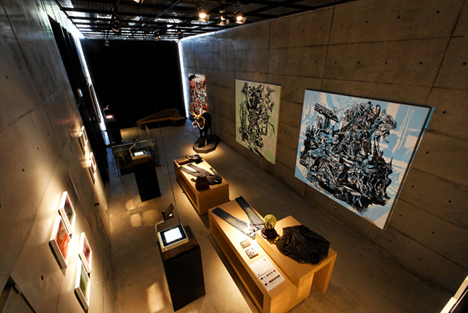
 Diesel Denim Gallery in Tokyo, Aoyama mixes avant-garde art with a selection of premium Diesel clothes. “Instead of going to sign a deal with a famous artist [...] we think that if we start from scratch and build a relationship with new upcoming talent, we can gain status.” (Japan Times, August 23rd, 2007, Staying casual in Minami-Aoyama) Other fashion luxury brands to co-opt the art world include Paul Smith (http://www.paulsmith.co.uk/personal/space-gallery/, accessed 20.01.2008. The shop is spread over 4 floors with a gallery set on the 4th Floor. In the ‘Space’ Gallery, a varied line up of British and European artist, photographers, and product designers are exhibited. See SuperFuture Online, http://www.superfuture.com/city/reviews/review.cfm?ID=309, accessed 20.01.2008), Gucci and Louis Vuitton, with its famous “The Culture of Branding” show in collaboration with the artist Murakami Takashi. Currid (2007) considers these cooperations built on the fact: “[...] underneath the glamour and frivolity of art and culture are real social and economic mechanisms [...]” (Currid 2007: xi)
Other concepts include to move a whole brand upscale, as seen in the case of Isetan, a department store targeting male customers. By lining up high-end items on the top-floor of their store in Shinjuku as though they were museum pieces, they want to attract customers. The idea proved extremely successful by adjusting the product portfolio to the middle-aged male customer who seeks to make a fashion statement (The Nikkei Weekly, November 5th, 2007, Retailer finds way into men's wallets: 20). Ace Gene started in February 2007 to polish its luxury image and achieved a big increase in its profit margins by equally moving upscale (The Nikkei Weekly, September 3rd, 2007, Sales gains of 10% are for sissies, p. 21. After opening its Hibiya flagship store, Ace Gene discontinued internet sales and stopped marketing through general merchandise stores, increasing the luxury image. Prices were raised by 25%. Domestic sales from February to June were 80% higher). Baccarat Pacific K.K., a subsidiary of a major crystal ware maker from France, has been showing rapid growth after changing its brand strategy from a producer of dish wares to a luxury brand. The brand created an environment which made the buying process more of a lifestyle experience (The branches in Marunochi and Roppongi are examples where this has been implemented. See The Nikkei Weekly, Baccarat Pacific K.K., March 26th, 2007, p. 20. Baccarat experienced a 300% sales gain from 1996 to 2006. The new strategy tried to nurture Baccarat as a luxury brand that serves many aspects of the customers' lifestyles. Some stores are now equipped with trendy bars where visitors have the opportunity to enjoy drinking with the glasses they choose. The bartenders are trained with product specific information and in the history of the brand).
The creation of flagship stores of European luxury brands started in 2001 with the $138-million La Maison Hermes and since then other luxury brands have followed the trend of engaging top architects to create spectacular shopping palaces. “Japanese refinement of the retail experience plus a general lack of attachment to old structures drives a style of shop development that has produced some of the new architectural temples of the century.” (Superfuture superguide Tokyo, online, http://supertalk.superfuture.com/supershop/superguides/superguides-tokyo.php, accessed 20.10.2008) The latest overseas brands to appear in the upscale shopping district of Ginza were Bulgari and Armani, both in November 2007. Having a presence in Tokyo is considered an important part in the image-creation and also a jumping point to other Asian luxury markets (Japan Times, October 15th, 2007, Upscale saloons pamper rich: 52).
Luxury brand online stores have created services for customers that are beyond the scope of the average shopping site on the internet. It becomes more important for luxury brands and fashion houses to improve their presence known online, leading to the emergence of a new generation of virtual Japanese shopping towns (Examples are megaseek for men/mfm, select square, zozoresort, and 109 men's net, see “Virtual Luxury”, Anterior Insight 2008. Fendi launched on September 2006 a 15 seconds Video Ad exclusively on style.com, making a step away from print advertising on billboards and in magazines. Virtual shopping itself to become the new retail medium for many high fashion and luxury brands).
Luxury companies should devise creative ways in which they can take shopping out of the usual context, giving consumers the opportunity to discover new things and experiences. In this way luxury brands are connected with emotional values of diverse consumer lifestyles by connecting with the specific 'triggers' that make a consumer's brand experience enriching and unique (The Financial Times, September 9th, 2007, What luxury means now; “Convenience Luxury”, Anterior Insight 2008; Danziger 2005: 30; Graham and Matthews 2004).
 Accessing wealthy clients and marketing to rich people in Japan represents a major challenge. In a shrinking market, knowing how to deal with affluent consumers who often form the solid base for a brand, can become an essential asset.