This is an online version of my working paper dealing with luxury marketing in Japan. It is updated regularily with comments being more than welcome. I will try to answer every comment and incorporate feedback as fast as possible. The online version includes interactive elements and comments not included in the print version. The actual PDF-file can be accessed here: Luxury Marketing in Japan.pdf (right-click to save file on hard disk).
Recent update: 13/09/2008 After several Interviews with Yamada Yu, Ypsilon Group, Masubuchi Tatsuya, Root and Partners, and meetings with Paul Goldsmith, Esprit Corp. and Kazuo Makino, Porsche Japan, parts of the paper were updated. The section on HNWI marketing in Japan (section 3.3) was enlarged.
Showing posts with label luxury marketing. Show all posts
Showing posts with label luxury marketing. Show all posts
Saturday, August 9, 2008

2. The “new rich” market
The consumer rich have become the main customer base for many luxury companies (Takahashi 2005: 11). They tend to be young, single, have a higher salary than members of the middle-class, and use their money freely for personal lifestyle consumption (Takahashi 2005; Usui 2005; Tsuchiya 2007). Their distinctive feature is that they do not have enough assets or income to show premium consumption in all aspects of their lives. Members of this group with lower income are “trading-up”, spending disproportionally in areas with emotional importance to them while economizing in others (Silverstein and Fiske 2005: 7). Individually, these shoppers may spend relatively small amounts, but their large numbers form a substantial amount of luxury sales. Many are on career paths that will have their income rise quickly, making their customer lifetime value (CLV) worthy of recognition (Chadha and Husband 2006: 58). Figure 2.1 shows all luxury consumers, grouped into three consumer levels that are representing different social environments and imply different marketing approaches. The levels will be detailed in section 3.2 in the three-level luxury marketing model.

1. Introduction
The defining attribute of services for rich people in Japan has been the face to face interaction in exclusive shops not meant for the normal middle class consumer. Before the economic bubble in the 1980s, luxury companies were defining their customers predominantly by income level. Their numbers were therefore fixed to a small elite and business could not be expanded beyond this scope without the danger of losing exclusivity. With the commodification of luxury and rising mass affluence, a change in the perception of the term occurred (Takahashi 2005: 10). In recent years the long taken-for-granted distinction between domestic and foreign brands is blurring and there is a greater tolerance for nontraditional lifestyle paths (Nikkei Weekly, July 16th, 2007, Debbie Howard, Japan's evolving consumer psyche creating opportunities, p. 32; Hirano and Miles 2006). Luxury consumers are turning into unpredictable shoppers that combine different brands and styles to form distinctive and personal lifestyles, and in response to that the variations between offerings are becoming ever more subtle (SIGMA 2005: 10; see also Ishiwata 2006: 7; Nunes et al. 2004: 57). A new demand for authenticity, corporate social responsibility (CSR), and an increasing translation of culture and arts into consumer products indicate a shift away from simple conspicuous consumption towards informed consumption (Currid 2007: 36; see also Scott 2000; Anterior Insight 2008; Nikkei Weekly, October 15th, 2007: 26).
Global Insight predicts that premium brands will grow 89.3% in Japan between 2005 and 2010, while volume brands will only grow 0.9% in the same period (Treece 2006). How can such an expansion in the luxury market be explained? Takahashi (2005) notes that if we take a look at the statistics of high taxpayers in Japan the market of rich people is expanding, but not in a way that would justify the rise in luxury sales that was experienced in the last decade. These new consumption patterns are attributed to the appearance of the “new rich” who, as a market, hold tremendous potential for luxury companies. The transformation of wealth from the traditional old rich families of entrepreneurs and real estate owners, to the newly affluent young business professionals, IT-entrepreneurs and retirement rich happened within the last 15 years, during and after the economic bubble of the 1980s.
As their major share of profit now comes from a much more diversified consumer, many premium companies that used to sell to a conservative, elitist, and upper-class group of luxury customers now face the challenge of how to satisfy the new demand for mass luxury while at the same time taking care not to devaluate the brand and lose their more upscale clients. I will argue that because of these developments, premium companies have to change their relationship with their most valuable customers: from an impersonal to one that will create the opportunity for long-term cooperation and trust. New ways to transmit an image of exclusivity are needed to keep the aspirational appeal of brands and products. The affluent consumers have become increasingly immune to the normal channels of mass marketing and now demand real communication and added value. In order to reach them, luxury companies have to get access to the most exclusive of all marketing environments: personal communication between consumers about luxury brands (word of mouth).
The paper is structured as follows: Paragraph 2 introduces briefly customer groups that are of special interest within “new rich” market. Paragraph 3 deals with marketing issues. Section 3.1 and 3.2 explain the basic approach to luxury marketing. Section 3.3 introduces companies that are essential cooperation partners for a successful strategy within the Japanese premium market and outlines the importance of creating a marketing environment for the most exclusive customers. In section 3.4 I will explain how to work with word of mouth marketing techniques in a HNWI environment.
Global Insight predicts that premium brands will grow 89.3% in Japan between 2005 and 2010, while volume brands will only grow 0.9% in the same period (Treece 2006). How can such an expansion in the luxury market be explained? Takahashi (2005) notes that if we take a look at the statistics of high taxpayers in Japan the market of rich people is expanding, but not in a way that would justify the rise in luxury sales that was experienced in the last decade. These new consumption patterns are attributed to the appearance of the “new rich” who, as a market, hold tremendous potential for luxury companies. The transformation of wealth from the traditional old rich families of entrepreneurs and real estate owners, to the newly affluent young business professionals, IT-entrepreneurs and retirement rich happened within the last 15 years, during and after the economic bubble of the 1980s.
As their major share of profit now comes from a much more diversified consumer, many premium companies that used to sell to a conservative, elitist, and upper-class group of luxury customers now face the challenge of how to satisfy the new demand for mass luxury while at the same time taking care not to devaluate the brand and lose their more upscale clients. I will argue that because of these developments, premium companies have to change their relationship with their most valuable customers: from an impersonal to one that will create the opportunity for long-term cooperation and trust. New ways to transmit an image of exclusivity are needed to keep the aspirational appeal of brands and products. The affluent consumers have become increasingly immune to the normal channels of mass marketing and now demand real communication and added value. In order to reach them, luxury companies have to get access to the most exclusive of all marketing environments: personal communication between consumers about luxury brands (word of mouth).
The paper is structured as follows: Paragraph 2 introduces briefly customer groups that are of special interest within “new rich” market. Paragraph 3 deals with marketing issues. Section 3.1 and 3.2 explain the basic approach to luxury marketing. Section 3.3 introduces companies that are essential cooperation partners for a successful strategy within the Japanese premium market and outlines the importance of creating a marketing environment for the most exclusive customers. In section 3.4 I will explain how to work with word of mouth marketing techniques in a HNWI environment.
3.1. The basic problem in luxury marketing
One general characteristic of the way consumers are building preferences and choices was named the “law of the few,” meaning the opinions of 10% of a consumer market is influencing the buying behavior of the other 90% (Lazarsfeld 1944). The marketing model (figure 3.1) in which a company employs the services of an advertising agency to create media that will influence the audience directly, is in truth a simplification.

The “two-step flow theory” states that instead of having a direct effect, advertising messages are channelled through opinion leaders with influence in social networks, and that it is through their output word of mouth that communication effects can occur (Katz and Lazarsfeld 1955). Opinion leaders process the information first, since they tend to be more frequently exposed to mass media (figure 3.2) (Richins and Root-Shaffer 1988).

The problem about changed consumer attitudes from a marketing perspective is the higher immunity of the discerning and highly sophisticated opinion leaders against traditional marketing channels and mass media. Especially HNWIs do not want to be targeted by direct push-approaches (figure 3.2) (Push marketing is the traditional direct type of marketing. It includes direct mail, advertising, cold calling, and other techniques that push your products and services). To get access to rich customers in general, and specifically their opinion leaders, different channels have to be employed. This is done with pull-approaches (Pull marketing brings customers to you by their own incentive. It is a more indirect approach that includes using proactive referral systems, speaking, writing, having a visible presence within communities and social networks, and providing additional information once the potential customers have given their permission to do so). Once a relationship based on trust is established, customers can be more receptive for direct push-approaches. A company's own customers can therefore be targeted more directly than new customers, leading to two different models of luxury marketing—customer acquisition and customer retention.
Customer acquisition
Acquiring customers for luxury brands must be differentiated by wealth level and the customer's marketing exclusivity, meaning the inclination of a consumer to be not receptive for mass marketing environments and mass media. The theory is that the higher the wealth level, the less receptive the customer is to normal marketing channels (Abraham-Holdings 2008A, Tsuchiya 2007: 76-77). Figure 3.3. shows marketing environments in a combination of the consumption level marketed in, and the media-channels used to transfer the message, the marketing exclusivity (It is important not to mistake consumption level with consumer level. The consumption level [figure 3.3] defines the relative price level of a product sold, advertised or otherwise marketed, while the consumer level [from figure 2.1 and table 3.1] defines the level of a consumer's social lifestyle and connections). Everything can be considered a marketing environment: the lobby of an expensive hotel, a private party, even a talk among friends can be the scene of a conversation about a product or service, or a setting for brand exposure and image building.
A change in marketing environment and consumer behavior has led to a gradual decline in the traditional mass market, with the so called “death in the middle” by companies who failed to differentiate themselves either by price (offering qualitative products in the discount market) or quality and emotional appeal (offering new luxury products and premium offerings, or changing the shopping environment). What has happened in the last decades is a gradual shift in marketing exclusivity from the left of figure 3.3 to the right. Consumers either demand more of their shopping experience or look out for the lowest price or convenience (Silverstein and Fiske 2005; Nunes et al. 2004; Danziger 2005; Anterior Insight 2008).

The higher the wealth level, the higher is the average marketing exclusivity of the marketing environment and the media necessary to gain access to the individual customer. Thorough customer segmentation can reveal at which media level the marketing has to be executed. As most brands have a product range which spans some or all of the consumption levels from figure 3.3, an holistic approach can be necessary. The problem in luxury marketing is how to reach the higher levels of marketing exclusivity, as these tend to vary depending on cultural context, are linked to specific networks, and are not directly accessible.
Customer Retention
The basic approach for customer retention is illustrated by Tsuchiya (2007), who makes three propositions: Proposition 1: 80% of the revenue is delivered by 20% of the customers of a luxury company. Proposition 2: Only about 10% of the customers are opinion leaders, while the other 90% tend to be heavily influenced by them in their buying decisions. Proposition 3: Customer acquisition is 10 times more costly than customer retention (Tsuchiya 2007: 40-41, 70-71).
Considering propositions 1 and 3, it makes sense to treat some customers better than others and to invest more energy into retaining their loyalty (Nunes et al. 2004: 57, Tsuchiya 2005, 40-41, 70-73). The challenge is now how to move the 10% opinion leaders of your 20% best customers up the loyalty ladder in order to become brand advocates, so that they can be effectively used for word of mouth marketing strategies, as can be seen in figure 3.4. To do this, special services are created for those 20% top customers in order to move them up the loyalty ladder, giving them status and incentives to talk about their positive experiences to others. This approach is already practiced in many industries: by airlines (mileage clubs), by credit card companies (fringe benefits and concierge services) and financial services providers (special treatment and privileges, private wealth management) (Nunes et al. 2004: 67).

As loyalty tends to increase only with extreme customer satisfaction, what is needed is outstanding performance and services (Hongoard 2002: 248). Relationship economies are strongest at the higher consumption levels, as market mechanisms are modified and eliminated at the top, where switching costs are caused by social factors like emotional attachment to products and conformity within social networks. In contrast, in the highly competitive middle-class environment the idea of extreme customer satisfaction is out of place due to low switching costs.


The “two-step flow theory” states that instead of having a direct effect, advertising messages are channelled through opinion leaders with influence in social networks, and that it is through their output word of mouth that communication effects can occur (Katz and Lazarsfeld 1955). Opinion leaders process the information first, since they tend to be more frequently exposed to mass media (figure 3.2) (Richins and Root-Shaffer 1988).

The problem about changed consumer attitudes from a marketing perspective is the higher immunity of the discerning and highly sophisticated opinion leaders against traditional marketing channels and mass media. Especially HNWIs do not want to be targeted by direct push-approaches (figure 3.2) (Push marketing is the traditional direct type of marketing. It includes direct mail, advertising, cold calling, and other techniques that push your products and services). To get access to rich customers in general, and specifically their opinion leaders, different channels have to be employed. This is done with pull-approaches (Pull marketing brings customers to you by their own incentive. It is a more indirect approach that includes using proactive referral systems, speaking, writing, having a visible presence within communities and social networks, and providing additional information once the potential customers have given their permission to do so). Once a relationship based on trust is established, customers can be more receptive for direct push-approaches. A company's own customers can therefore be targeted more directly than new customers, leading to two different models of luxury marketing—customer acquisition and customer retention.
Customer acquisition
Acquiring customers for luxury brands must be differentiated by wealth level and the customer's marketing exclusivity, meaning the inclination of a consumer to be not receptive for mass marketing environments and mass media. The theory is that the higher the wealth level, the less receptive the customer is to normal marketing channels (Abraham-Holdings 2008A, Tsuchiya 2007: 76-77). Figure 3.3. shows marketing environments in a combination of the consumption level marketed in, and the media-channels used to transfer the message, the marketing exclusivity (It is important not to mistake consumption level with consumer level. The consumption level [figure 3.3] defines the relative price level of a product sold, advertised or otherwise marketed, while the consumer level [from figure 2.1 and table 3.1] defines the level of a consumer's social lifestyle and connections). Everything can be considered a marketing environment: the lobby of an expensive hotel, a private party, even a talk among friends can be the scene of a conversation about a product or service, or a setting for brand exposure and image building.
A change in marketing environment and consumer behavior has led to a gradual decline in the traditional mass market, with the so called “death in the middle” by companies who failed to differentiate themselves either by price (offering qualitative products in the discount market) or quality and emotional appeal (offering new luxury products and premium offerings, or changing the shopping environment). What has happened in the last decades is a gradual shift in marketing exclusivity from the left of figure 3.3 to the right. Consumers either demand more of their shopping experience or look out for the lowest price or convenience (Silverstein and Fiske 2005; Nunes et al. 2004; Danziger 2005; Anterior Insight 2008).

The higher the wealth level, the higher is the average marketing exclusivity of the marketing environment and the media necessary to gain access to the individual customer. Thorough customer segmentation can reveal at which media level the marketing has to be executed. As most brands have a product range which spans some or all of the consumption levels from figure 3.3, an holistic approach can be necessary. The problem in luxury marketing is how to reach the higher levels of marketing exclusivity, as these tend to vary depending on cultural context, are linked to specific networks, and are not directly accessible.
Customer Retention
The basic approach for customer retention is illustrated by Tsuchiya (2007), who makes three propositions: Proposition 1: 80% of the revenue is delivered by 20% of the customers of a luxury company. Proposition 2: Only about 10% of the customers are opinion leaders, while the other 90% tend to be heavily influenced by them in their buying decisions. Proposition 3: Customer acquisition is 10 times more costly than customer retention (Tsuchiya 2007: 40-41, 70-71).
Considering propositions 1 and 3, it makes sense to treat some customers better than others and to invest more energy into retaining their loyalty (Nunes et al. 2004: 57, Tsuchiya 2005, 40-41, 70-73). The challenge is now how to move the 10% opinion leaders of your 20% best customers up the loyalty ladder in order to become brand advocates, so that they can be effectively used for word of mouth marketing strategies, as can be seen in figure 3.4. To do this, special services are created for those 20% top customers in order to move them up the loyalty ladder, giving them status and incentives to talk about their positive experiences to others. This approach is already practiced in many industries: by airlines (mileage clubs), by credit card companies (fringe benefits and concierge services) and financial services providers (special treatment and privileges, private wealth management) (Nunes et al. 2004: 67).

As loyalty tends to increase only with extreme customer satisfaction, what is needed is outstanding performance and services (Hongoard 2002: 248). Relationship economies are strongest at the higher consumption levels, as market mechanisms are modified and eliminated at the top, where switching costs are caused by social factors like emotional attachment to products and conformity within social networks. In contrast, in the highly competitive middle-class environment the idea of extreme customer satisfaction is out of place due to low switching costs.

3. Marketing Strategies
I will distinguish two different forms of premium marketing: The first is rich marketing which considers strategies to target individuals with high net worth (HNWIs) or a very high income, who are able to uphold a luxurious lifestyle in all aspects, including an upper class social life (level 3 in figure 2.1). The other term is luxury marketing, defined by Takahashi (2005) as strategies to target customers of luxury companies, may they be rich, mass affluent, or simply normal middle-class consumers who are trading-up (levels 1-3 in figure 2.1). Thus, rich marketing is a part of luxury marketing. In the following sections 3.1 to 3.4 I will present six main arguments:
1) (in section 3.1) The basic problem of luxury marketing is the rising immunity of the consumer, especially among level 3, to normal marketing channels. People do not respond to marketing advances in a direct way. Instead, the messages are filtered and adjusted by opinion leaders. Customer acquisition needs to take into account the media- and marketing exclusivity of the targeted customer.
2) (in section 3.1) Customer retention in luxury marketing calls for a segmentation of a luxury companies' customers, with additional benefits made available for those who provide the major part of revenue.
3) (in section 3.2) The change in the way luxury is consumed and perceived leads to a more diversified consumer buying premium products. Companies have to develop a holistic approach by targeting more than one customer segment, and more than one consumer level.
4) (in section 3.2) Exactly this change has altered the way rich marketing has to be executed. The most exclusive consumers (level 3) have to be targeted by using different channels in order to acquire them as customers, and have to be treated in special ways distinct from others for customer retention.
5) (in section 3.3) Doing this in Japan requires the help of specialized companies who offer luxury companies tools for accessing level 3 consumers (through specialized media or the creation of a marketing environment), and for enhancing their service level for the top customers.
6) (in section 3.4) Consumers are not only important as revenue makers but also as influencers. Word of mouth is more important in a HNWI marketing environment. Companies have to calculate the worth of customers by CRV (customer referral value), not simply by CLV (customer lifetime value) (Katz et al. 2008), and have to employ event marketing strategies that accelerate and induce word of mouth as well as positive PR.
1) (in section 3.1) The basic problem of luxury marketing is the rising immunity of the consumer, especially among level 3, to normal marketing channels. People do not respond to marketing advances in a direct way. Instead, the messages are filtered and adjusted by opinion leaders. Customer acquisition needs to take into account the media- and marketing exclusivity of the targeted customer.
2) (in section 3.1) Customer retention in luxury marketing calls for a segmentation of a luxury companies' customers, with additional benefits made available for those who provide the major part of revenue.
3) (in section 3.2) The change in the way luxury is consumed and perceived leads to a more diversified consumer buying premium products. Companies have to develop a holistic approach by targeting more than one customer segment, and more than one consumer level.
4) (in section 3.2) Exactly this change has altered the way rich marketing has to be executed. The most exclusive consumers (level 3) have to be targeted by using different channels in order to acquire them as customers, and have to be treated in special ways distinct from others for customer retention.
5) (in section 3.3) Doing this in Japan requires the help of specialized companies who offer luxury companies tools for accessing level 3 consumers (through specialized media or the creation of a marketing environment), and for enhancing their service level for the top customers.
6) (in section 3.4) Consumers are not only important as revenue makers but also as influencers. Word of mouth is more important in a HNWI marketing environment. Companies have to calculate the worth of customers by CRV (customer referral value), not simply by CLV (customer lifetime value) (Katz et al. 2008), and have to employ event marketing strategies that accelerate and induce word of mouth as well as positive PR.
3.2. A three-level luxury marketing model
The following analysis will differentiate between [consumer level 1] people who buy products of a luxury company and therefore qualify as luxury consumers but do not have the assets or income to qualify them for a rich lifestyle (trading-up), [consumer level 2] people exhibiting a high salary that enables them luxury consumption in certain categories, but not all, and [consumer level 3] people encompassing both HNWIs and people with an extraordinary income, qualifying them for an active premium consumption lifestyle (table 3.1).
Most premium companies do not restrict their portfolio to one consumption level (figure 3.3) but offer products in all top three categories (premium, luxury, and ultra-luxury level). The key is to provide “luxury for the masses as well as the classes” (Danziger 2005), delivering luxury to the top while simultaneously to the population at large.

In table 3.1, the following descriptions are summarized. The marketing exclusivity of the consumers rises with their consumer level. The opinion leaders in all three levels are different.
Level 1 - Trading-up level. Many brands already have adapted to serve this “mass luxury consumer”. At this level, conformist consumption is predominant, with a strong influential presence of social leadership. Consumers are interested in being “in”, buying trend-conformist luxury products that help to transfer chains of associations to their surroundings. They are trading-up in order to spend on luxury brand items and to afford premium products with emotional importance to them. Reaching this kind of consumer still heavily depends on the use of mass marketing in combination with opinion leader marketing by reaching network hubs from the respective social milieu in level 1 (friends and classmates, colleagues), level 2 consumers that have idolizing character (the superiors of level 1 consumers, members of higher social classes), and by having the right level 3 consumer using more upscale products from the same brand. Individualized lifestyle consumption is still rare at this level. Individuals are checked and judged within their social environment by their conformity to group standards. In the fashion segment, the influence of style magazines and celebrities is strong. Even among level 1 consumers, there is the tendency to become more immune to normal mass marketing channels. So event marketing and pull approaches can be necessary in order to enter the lives of these customers. This is also important for the identification of the above mentioned opinion leaders (see section 3.4).
This level's main characteristic is being accessible in price and physical location, in sharp contrast to the personalized, away from the public strategy deployed to serve HNWIs (Chadha and Husband 2006: 50. It entails having a strategy of lower price points, making part of the range accessible to the consumer rich. This changed the segmentation policy of many premium brands leading to entry products that are well seen in the automotive segment [with entry models such as the A3, the Mercedes A-Class or the BMW 1 Series] and luxury fashion brands [with perfumes offering the cheapest entry into the image of famous brands]). The danger of selling at this consumer level is the potential devaluation of a brand, so it is important for luxury companies to maintain a distinct character and meaning for the products at each consumption level, as well as to clearly articulate the main brand characteristics all the products share (Silverstein and Fiske 2005: 12).
Level 2 - Premium level. Members of this consumer level freely combine conspicuous consumption and individualized lifestyle consumption. They are interested in products that exemplify their taste and personality, and buy luxury, premium, and mass market products. They either have a high income, but low assets (young professionals, corporate climbers in medium to high positions, young entrepreneurs of small companies), or high assets but low income (the retirement rich). Their opinion leaders are members of their respective social milieus (upper professional environment in the case of corporate climbers, colleagues in the case of professional doctors and lawyers, old colleagues and friends in the case of the retirement rich). Celebrity role models are still important but do not have the same impact as on level 1. More important are role models within the respective social environment, as those lifestyles are within immediate reach. Instead of aspiring to become their idol and consuming upper class luxury for the sake of conspicuous consumption, level 2 consumers are imitating social codes of the upper class in order to belong, to be accepted by the respective social milieu. Level 1 consumers are buying luxury goods as a form of imitating their favorite idol or the upper class, influenced by the "very impossibility of attaining what one wishes for" (Allison 2000: 124), the perceived lack finding expression in the fetish: the luxury product. "The fetish substitute for the thing that is desired [an upper class lifestyle] but is impossible to obtain." (Kelsky 2001: 26) At level 2, the luxury product is not the fetish that substitutes the real want of belonging to a different social class, because the upper class lifestyle is either within reach or already attained to some extent. So here the obtained luxury product or service itself, considered appropriate to one's own lifestyle or level of social success, gives the consumer pleasure by transferring that message to others. Level 2 consumers either purchase luxury in accordance to the social codes of their level within the corporate or professional hierarchy, or in case of the retirement rich, consume luxury as a way to reward themselves for a lifetime of work.
There is a lot of potential in this level by mass targeting specific consumer rich segments, such as the Japanese baby boomer generation, corporate climbers, and affluent women in their 40s. In order to distinguish these offers from normal products, it is essential to clearly mark them as being special, by creating luxury spaces within department stores in which the upscale consumer can feel more comfortable (Danziger 2005: 101). A change in product segmentation could include creating aspirational appeal while simultaneously making a brand more accessible and more competitive by boosting demand with entry-level products (“Accessible super premium” items are priced near the top of the category, but are still affordable to the middle-market, because they are relatively low-ticket items. “Old luxury brand extensions” are lower priced versions of products created by companies whose brands have traditionally been affordable only for the rich. See Nunes et al. 2004: 10). The marketing exclusivity to reach level 2 customers has to be higher than on level 1, by making the offers and approaches more personally relevant to the respective customer segments, and by appealing to their heightened sophistication that marks them as different from level 1 consumers. Level 2 consumers want to have their more informed consumption patterns recognized. Word of mouth strategies have to target opinion leaders within their different social environments. With their lifestyles, tastes, and mind sets varying tremendously, thorough segmentation and milieu analysis is needed.
Level 3 - Luxury level. Level 3 consumers refrain from discount and mass market stores, and either have a high income and high assets or extremely high income with low assets. In order to reach them, specialized magazines, limited-access internet sites, word-of-mouth, and event marketing strategies with high marketing exclusivity have to be implemented. Their distinguishing characteristics are their regular connections to exclusive marketing environments and extensive contacts to various networks of other rich people. This level clearly demarcates "another world", far away from the normal mass luxury consumer. Members of this group include very successful professional rich (doctors and lawyers), entrepreneurs after a successful IPO (Initial Public Offering. A company issues shares to the public for the first time in order to expand its capital), “super-salarymen” of foreign financial institutions, rich business owners, board members of big corporations, and the wives and girlfriends of the rich and powerful.
In contrast with level 2 consumers, the networks of level 3 consumers are connected by the fact that they all belong to the "upper class"—they have access to a different kind of social environment to which level 2 consumers do not, but aspire to and want to gain access. So when targeting opinion leaders, marketers should be aware of the fact that even though there are different networks within level 3, they are interconnected by social gatherings where level 3 people from different networks are invited. Simply put, level 2 consumers do not all go to the same party but stay, more or less, within their respective social environments. Level 3 consumers on the other hand—due to their connections, higher income level and often tremendous assets—can achieve another level of social interconnectedness where it is possible for them to meet people from distant networks more easily. They have the capability to set themselves apart from the normal social gatherings of middle-class people. They think of themselves as wealthy and want to be treated accordingly. Many customers in this group are often disappointed by the service level provided to them by luxury companies, and would be willing to spend more in many categories, could they find offerings that are more tailored to their individual needs (Nunes et al. 2004: 13). In interviews conducted with HNWI customers, one of the things mentioned most often was their feeling that their customer value is not recognized and not appreciated. To quote Paul Goldsmith, CEO Esprit Corporation in Tokyo: "Today a customer buying a $800 handbag is treated better than someone buying a $100,000 car." (Interview with Paul Goldsmith, 19.08.2008, Tokyo)
Therefore, the essential point is to create environments that are limited, where the higher customer value of level 3 consumers is recognized. This is done by using techniques such as club-marketing, where rich people are gathered by common interests, in combination with added value conferred by privileges, concierge services, and special experiences that are neither mundane nor easily accessible (See Takahashi 2005, pp. 17-19). In such an environment word of mouth strategies can be effectively executed by providing access to other level 3 consumers. This creates a setting for reaching distant networks of luxury consumers who are not yet customers of the luxury company (see section 3.4).
All three levels require a deep customer understanding and will serve a mixed group of customers, so companies will need to develop “a kind of drive-through approach to segmentation.” (Allen and Rigby 2005: 3) The amount of exclusivity needed for the marketing approach depends on the brand profile in question and the consumption style of the customers. On all three consumer levels, luxury products are consumed. Consumers can change their level, which is a dynamic social process, with the transition taking place predominantly between level 2 and 3. Rich marketing (for level 3) has a profound influence on the other levels of luxury marketing (level 2 and 1), in such a way that the selection of level 3 customers forms the image of a brand that is consumed by level 1 and 2, due to the media coverage of the luxury lifestyles of celebrities and other level 3 consumer (Currid 2007; Chadha and Husband 2006). The expanded luxury marketing model in figure 3.6 incorporates the three consumer levels.

Most premium companies do not restrict their portfolio to one consumption level (figure 3.3) but offer products in all top three categories (premium, luxury, and ultra-luxury level). The key is to provide “luxury for the masses as well as the classes” (Danziger 2005), delivering luxury to the top while simultaneously to the population at large.

In table 3.1, the following descriptions are summarized. The marketing exclusivity of the consumers rises with their consumer level. The opinion leaders in all three levels are different.
Level 1 - Trading-up level. Many brands already have adapted to serve this “mass luxury consumer”. At this level, conformist consumption is predominant, with a strong influential presence of social leadership. Consumers are interested in being “in”, buying trend-conformist luxury products that help to transfer chains of associations to their surroundings. They are trading-up in order to spend on luxury brand items and to afford premium products with emotional importance to them. Reaching this kind of consumer still heavily depends on the use of mass marketing in combination with opinion leader marketing by reaching network hubs from the respective social milieu in level 1 (friends and classmates, colleagues), level 2 consumers that have idolizing character (the superiors of level 1 consumers, members of higher social classes), and by having the right level 3 consumer using more upscale products from the same brand. Individualized lifestyle consumption is still rare at this level. Individuals are checked and judged within their social environment by their conformity to group standards. In the fashion segment, the influence of style magazines and celebrities is strong. Even among level 1 consumers, there is the tendency to become more immune to normal mass marketing channels. So event marketing and pull approaches can be necessary in order to enter the lives of these customers. This is also important for the identification of the above mentioned opinion leaders (see section 3.4).
This level's main characteristic is being accessible in price and physical location, in sharp contrast to the personalized, away from the public strategy deployed to serve HNWIs (Chadha and Husband 2006: 50. It entails having a strategy of lower price points, making part of the range accessible to the consumer rich. This changed the segmentation policy of many premium brands leading to entry products that are well seen in the automotive segment [with entry models such as the A3, the Mercedes A-Class or the BMW 1 Series] and luxury fashion brands [with perfumes offering the cheapest entry into the image of famous brands]). The danger of selling at this consumer level is the potential devaluation of a brand, so it is important for luxury companies to maintain a distinct character and meaning for the products at each consumption level, as well as to clearly articulate the main brand characteristics all the products share (Silverstein and Fiske 2005: 12).
Level 2 - Premium level. Members of this consumer level freely combine conspicuous consumption and individualized lifestyle consumption. They are interested in products that exemplify their taste and personality, and buy luxury, premium, and mass market products. They either have a high income, but low assets (young professionals, corporate climbers in medium to high positions, young entrepreneurs of small companies), or high assets but low income (the retirement rich). Their opinion leaders are members of their respective social milieus (upper professional environment in the case of corporate climbers, colleagues in the case of professional doctors and lawyers, old colleagues and friends in the case of the retirement rich). Celebrity role models are still important but do not have the same impact as on level 1. More important are role models within the respective social environment, as those lifestyles are within immediate reach. Instead of aspiring to become their idol and consuming upper class luxury for the sake of conspicuous consumption, level 2 consumers are imitating social codes of the upper class in order to belong, to be accepted by the respective social milieu. Level 1 consumers are buying luxury goods as a form of imitating their favorite idol or the upper class, influenced by the "very impossibility of attaining what one wishes for" (Allison 2000: 124), the perceived lack finding expression in the fetish: the luxury product. "The fetish substitute for the thing that is desired [an upper class lifestyle] but is impossible to obtain." (Kelsky 2001: 26) At level 2, the luxury product is not the fetish that substitutes the real want of belonging to a different social class, because the upper class lifestyle is either within reach or already attained to some extent. So here the obtained luxury product or service itself, considered appropriate to one's own lifestyle or level of social success, gives the consumer pleasure by transferring that message to others. Level 2 consumers either purchase luxury in accordance to the social codes of their level within the corporate or professional hierarchy, or in case of the retirement rich, consume luxury as a way to reward themselves for a lifetime of work.
There is a lot of potential in this level by mass targeting specific consumer rich segments, such as the Japanese baby boomer generation, corporate climbers, and affluent women in their 40s. In order to distinguish these offers from normal products, it is essential to clearly mark them as being special, by creating luxury spaces within department stores in which the upscale consumer can feel more comfortable (Danziger 2005: 101). A change in product segmentation could include creating aspirational appeal while simultaneously making a brand more accessible and more competitive by boosting demand with entry-level products (“Accessible super premium” items are priced near the top of the category, but are still affordable to the middle-market, because they are relatively low-ticket items. “Old luxury brand extensions” are lower priced versions of products created by companies whose brands have traditionally been affordable only for the rich. See Nunes et al. 2004: 10). The marketing exclusivity to reach level 2 customers has to be higher than on level 1, by making the offers and approaches more personally relevant to the respective customer segments, and by appealing to their heightened sophistication that marks them as different from level 1 consumers. Level 2 consumers want to have their more informed consumption patterns recognized. Word of mouth strategies have to target opinion leaders within their different social environments. With their lifestyles, tastes, and mind sets varying tremendously, thorough segmentation and milieu analysis is needed.
Level 3 - Luxury level. Level 3 consumers refrain from discount and mass market stores, and either have a high income and high assets or extremely high income with low assets. In order to reach them, specialized magazines, limited-access internet sites, word-of-mouth, and event marketing strategies with high marketing exclusivity have to be implemented. Their distinguishing characteristics are their regular connections to exclusive marketing environments and extensive contacts to various networks of other rich people. This level clearly demarcates "another world", far away from the normal mass luxury consumer. Members of this group include very successful professional rich (doctors and lawyers), entrepreneurs after a successful IPO (Initial Public Offering. A company issues shares to the public for the first time in order to expand its capital), “super-salarymen” of foreign financial institutions, rich business owners, board members of big corporations, and the wives and girlfriends of the rich and powerful.
In contrast with level 2 consumers, the networks of level 3 consumers are connected by the fact that they all belong to the "upper class"—they have access to a different kind of social environment to which level 2 consumers do not, but aspire to and want to gain access. So when targeting opinion leaders, marketers should be aware of the fact that even though there are different networks within level 3, they are interconnected by social gatherings where level 3 people from different networks are invited. Simply put, level 2 consumers do not all go to the same party but stay, more or less, within their respective social environments. Level 3 consumers on the other hand—due to their connections, higher income level and often tremendous assets—can achieve another level of social interconnectedness where it is possible for them to meet people from distant networks more easily. They have the capability to set themselves apart from the normal social gatherings of middle-class people. They think of themselves as wealthy and want to be treated accordingly. Many customers in this group are often disappointed by the service level provided to them by luxury companies, and would be willing to spend more in many categories, could they find offerings that are more tailored to their individual needs (Nunes et al. 2004: 13). In interviews conducted with HNWI customers, one of the things mentioned most often was their feeling that their customer value is not recognized and not appreciated. To quote Paul Goldsmith, CEO Esprit Corporation in Tokyo: "Today a customer buying a $800 handbag is treated better than someone buying a $100,000 car." (Interview with Paul Goldsmith, 19.08.2008, Tokyo)
Therefore, the essential point is to create environments that are limited, where the higher customer value of level 3 consumers is recognized. This is done by using techniques such as club-marketing, where rich people are gathered by common interests, in combination with added value conferred by privileges, concierge services, and special experiences that are neither mundane nor easily accessible (See Takahashi 2005, pp. 17-19). In such an environment word of mouth strategies can be effectively executed by providing access to other level 3 consumers. This creates a setting for reaching distant networks of luxury consumers who are not yet customers of the luxury company (see section 3.4).
All three levels require a deep customer understanding and will serve a mixed group of customers, so companies will need to develop “a kind of drive-through approach to segmentation.” (Allen and Rigby 2005: 3) The amount of exclusivity needed for the marketing approach depends on the brand profile in question and the consumption style of the customers. On all three consumer levels, luxury products are consumed. Consumers can change their level, which is a dynamic social process, with the transition taking place predominantly between level 2 and 3. Rich marketing (for level 3) has a profound influence on the other levels of luxury marketing (level 2 and 1), in such a way that the selection of level 3 customers forms the image of a brand that is consumed by level 1 and 2, due to the media coverage of the luxury lifestyles of celebrities and other level 3 consumer (Currid 2007; Chadha and Husband 2006). The expanded luxury marketing model in figure 3.6 incorporates the three consumer levels.

3.3 HNWI marketing solutions in Japan
There are several service providers that offer luxury companies in Japan access to tools necessary for both customer retention and customer acquisition of HNWI customers. Some of them are providing creative ways for accessing level 3 consumers, by increasing the marketing exclusivity of magazines, by creating special media solely for HNWIs, or by the use of direct marketing in cooperation with credit card companies and mileage clubs. What the companies have in common is that they all give access to selected databases of HNWIs, and then offer some kind of service to enhance the customer loyalty programs of client companies. The basic goal of all of them is to change the way rich marketing is performed: to get away from luxury marketing via normal media channels and go to a higher level of marketing exclusivity. By excluding customers from accessing special services, by limiting the audience and offering preferred treatment within a specially created marketing environment, the image of mass marketing is transformed into one-to-one marketing.
The most exclusive marketing environments, as mentioned before, are the conversations between consumers, or word of mouth. As will be outline in section 3.4, word of mouth marketing methods are especially suited to reach HNWIs. In order to make full use of this marketing approach, an environment has to be created where people with higher marketing exclusivity can meet and exchange information. This environment is always connected to a database of rich people—HNWIs and sometimes even ultra-HNWIs—and forms the primary asset of businesses that are presented below. The more detailed the information on their consumer habits and lifestyles and the closer the relationship of the service company to these rich consumers, the higher is the value that can be offered to luxury companies that want to do business with them. Taking care of such a database, keeping it up to date, devising creative methods to add detail to data sets, and creating new ways to increase the size of the database—all these are basic practices necessary in HNWI business that are often beyond the scope of the marketing department of even the most sophisticated luxury companies.
An important factor to consider is whether or not there are incentives for rich people to belong to that database, meaning that once the motivation on the side of a HNWI is lost, this specific data set is basically worthless. Just a list of addresses with income brackets can be useful but can't be used to generate marketing exclusivity. What the companies described below offer to luxury companies in Japan is the exclusivity of their contact to HNWI people. As will be seen, some offer more exclusivity and better contacts than others. To explain figure 3.3 again, high marketing exclusivity means the access to exclusive environments and the permission to contact people in those environments who refrain from the lower levels of marketing exclusivity. Furthermore, as described in section 3.1, getting contact is only one side of luxury marketing. For customer retention, special loyalty programs have to be executed, in order to keep the level of contact from declining, and the customers from defecting. Let us now take a look at the companies in detail.
Abraham-Holdings and YUCASEE
Abraham-Holdings is a small company specializing in on wealth management advice for HNWIs and consulting for companies that operate in the rich market. It describes two points as missing in present services for the rich: they are not accessible on the internet and do not offer the information wanted by HNWIs. According to the company, it is a widely known fact that the information literacy of the new rich in Japan is high, but the industry has not reacted properly to that trend. The danger for luxury companies that offer services on the web is a possible brand devaluation. The YUCASEE solution was developed with those two problems in mind. It forms a social networking service (SNS) only for HNWIs with assets more than 100 million Yen (approximately 600.000 Euros). Abraham-Holdings guarantees a strict system of invitation and checking of possible new members (Abraham-Holdings 2007b).
YUCASEE offers an environment for HNWIs to get access to products that are specifically keyed to their needs, meaning a mature SNS with high-class information and advertising limited to products and offers aimed at rich clients. By creating this environment, Abraham-Holdings separates the market for HNWIs from the normal mass market. The solution has some limitations. By limiting entry to only HNWIs with more than 100 Mill. Yen in assets, the clientele does not represent the customer profile of most luxury companies, but only consumer level 3 customers. A SNS benefits from the number of users in order to achieve significant network effects and the number of households with such high assets is severely limited. The main question for evaluating the service will be the number of HNWIs that are members of YUCASEE. Abraham-Holdings does not disclose this information due to confidentiality issues (Interview with Takaoka Souichiro, CEO of Abraham-Holdings, Tokyo, Kamiyacho, 01.04.2008).
Ypsilon Group
The club marketing strategy by the Ypsilon Group aims to provide high-quality services to client companies that want to execute premium treatment (“concierge services”) for special customers. The Ypsilon Group is offering its own “amusement menu” of art, travel experiences, exclusive restaurants, music events, and concerts. It then offers the created “amusement” to members of its own membership club or the customers of the tie-up companies (Ypsilon Group website, <http://www.ypsilon-group.com/service/business_service.html>).
Research executed for over five years gives Ypsilon Group a database on rich services and a network of shops, restaurants, and businesses that is probably the most extensive of its kind in Japan. Up to date, the Ypsilon Group is the only company that is able to offer concierge services on such a high level to companies in the premium market (This database is used by Diners Club Japan to give its elite members concierge services. American Express executes its own concierge services, attaining a quality level comparable with the one from Ypsilon Group. Quintessentially, a company offering concierge services, based in Great Britain, opened a subsidiary in Japan in October 2007, but is not yet able to support an infrastructure like this). Further, taking up the trend of art and culture within HNWI business, the “art produce” mechanism was created for the sponsoring of young artists. At present Ypsilon Group has monthly exhibitions at headquarters, connected to a party with many prominent guests. Companies who use these services are Diners Club, ANA, Mistukoshi Department Store, and the exclusive Japanese credit card JCB “the class.”
The goal of these services is to bring customers from client companies together with level 3 consumers from distant networks, therefore increasing social inter-connectedness and creating added value for the consumers who are participating. By providing events linked to their interests in the arts, culture, and music, an atmosphere is created that does not give the image of a direct marketing attempt. The networking among the participating level 3 consumers is now conducted within a neutral environment, as opposed to, for example, a trade show or a brand event for obvious deliberate marketing. This atmosphere accelerates word of mouth and, by bringing together people from different business fields, makes the passage of information from one network to another possible (Stroper 1997).
Ypsilon Group's goal is for the existing customers of luxury companies to associate art exhibitions and other events with the brands of client companies, and also to enhance their CSR activities. The manufactured image is regarded as being cosmopolitan and sophisticated—it is not only for status. From December 2008 on, Ypsilon Group plans to expand its services to offer client companies customized events that can be used to invite both existing customers and level 3 consumers from its own database. By inviting people from its own membership club, Ypsilon Group provides client companies with access to approximately 7,000 HNWIs. This will offer an opportunity for both customer acquisition and retention, as can be seen in figure 3.7.
As the people in the database are themselves customers of the personal concierge service
offered by the Ypsilon Group since 2004, not only customers of luxury companies, the database is not tied to any specific brand or company. This point is important, for they expect to be contacted for special services and events as they are members by their own initiative to get exactly this kind of attention. So the database of rich people offered has three important characteristics: 1) it includes many famous and connected opinion leaders that joined the database in order to get special privileges and services, 2) it is brought into connection with arts and culture considered to be sophisticated, and 3) any approach made to these people is not considered push but pull-marketing. No direct marketing effort is made but companies get access to a network of connected rich people, and get them to mingle with their own customers. This marketing environment can now be used to start word of mouth strategies (detailed in section 3.4) in order to enter the highest marketing exclusivity: one-on-one communication among the rich and influential about luxury products.
For companies in the development phase of creating membership services for their customers, the Ypsilon Group offers its own marketing experts and furthermore works together with KT Marketing (detailed below) and employs independent experts that have extensive know-how and connections in the HNWI business.
AdComm
The company led by the German CEO Andreas Dannenberg offers an interesting service for the acquisition and retention of HNWI customers with its luxury “Whitebook”, a high-class magazine that is published four times a year. It is filled with articles by an assortment of 8-12 brands, all coming from different consumer segments in the luxury segment, representing one company out of their field (automotive, jewelry, travel, fashion, interior, etc.). It is not available to the general public. Rather, it is sent to top VIP customers of each of the participating brands, each copy being personalized with the logo as well a letter from the president of the respective company that the customer has acquired a product from (AdComm website, <http://www.ad-comm.com/EN/whatsnew/index.cfm?news=8>).
The Whitebook is essentially a virtual database of selected, highly complementary brands and their most valued customers. It offers brands a platform to create associations and transmit images of their core values and beliefs in a less direct manner than plain advertising, and is designed to introduce current and potential customers of one brand to the products and services of others. The magazine has a unit volume (depending on the databases of participating companies) of approximately 20,000 copies. Cooperating luxury companies in the winter 2007 issue have been: Hennessy (fine wine & spirits), Porsche (automobile), Bang & Olufsen (audio & visual), Casina (interior), Steinway & Sons (musical instruments), Lufthansa (airlines), De Beers (jewelry), and Ralph Lauren (fashion). The magazine not only features brand stories, but original content created by a specialized editorial team with a different theme in each issue. Topics include the world’s finest chefs and cuisine, arts and music, as well as philanthropy, clearly taking up the trend in luxury for “informed consumption.” (Among the articles that have appeared on page 1 of past issues are essays by novelist Jiro Asada and other popular writers such as Natsuki Ikezawa and Nozomu Hayashi, and an interview with ballet dancer Tetsuya Kumakawa) The magazine has also published articles introducing people who engage in humanitarian and CSR activities (Examples are the Association for Aid and Relief, Japan, a nonprofit organization helping refugees, the Japan chapter of Medecins Sans Frontieres, the Japan Guide Dog Association and other organizations), and stories on the work of distinguished Japanese artists from a number of fields, including sculpture and calligraphy. It further features a password protected, closed-user group website with expanded features, as well as a series of special co-partnered events among the participating brands. Companies profit from the association with other strong brands and can reach the shared customer bases of all participating brands (Events include Christmas parties for readers of the magazine, trips to the French winery of Dom Perignon where readers can meet the chief vintner and another to visit the head office of Harry Winston on Fifth Avenue, in New York, to let participants see how jewelry is made).
By not directly advocating specific products but providing information on the brand values, the advertisement becomes a pull-approach that allows to “access the living rooms” of selected HNWIs who come from different networks.
KT Marketing
KT Marketing is a highly-specialized consulting company with specific know-how on the HNWI market in Japan. Prominent client companies include Lexus, Jaguar, Audi, Hummer, Mitsubishi Real Estate, Nomura Real Estate, Mitsukoshi Department Store, Diners Club International, Citigroup, Lexus and the extremely successful Isetan department store. It offers consulting on rich marketing and club-marketing strategies, as well as help for the execution of respective services. It proposes that companies who wish to expand their rich customer group should concentrate on the consumer rich and engage in collaborations with successful luxury companies and brands that have customers with similar consumption patterns (KT Marketing 2008).
The “VIP project” aims at increasing the loyalty of premium customers of client companies. After selecting premium customers who have to be cultivated, the loyalty of this group is increased by CRM measures and loyalty programs. The “blackcard project” maximizes the lifestyle experience of selected premium credit card owners, analyzing their consumer behavior and then constructing a membership service with especially high conditions for admission.
By accessing customer databases of credit card companies and mileage clubs, client companies can access HNWIs with an indirect push-approach. A cooperation with the Ypsilon Group for the execution of concierge services further adds to the assets of this company.
Roots and Partners
Several introduced companies have HNWI databases. The question is now what kind of relationship does the service company have with them? It can range from anonymous address lists (credit card companies), over customer databases that give legitimation to establishing contact (AdComm), to HNWIs that are themselves customers of the service company (as in the case of the private concierge services of the Ypsilon Group). But what about personal contact? What better legitimizing value for inviting someone could there be than to know them directly, having met several times, maybe even done business with them? Following the argumentation by Stanley (1997) direct contact and acquiring up to date information on HNWIs demands exactly this kind of personal involvement. There is simply no other way to get reliable data. Asking affluent for their incomes does not produce accurate results, doing business with them over several years does. As HNWIs tend to value their privacy and only trust sources that are not directly motivated by business alone, what is needed is an intermediary, an agent, someone who can convincingly claim independence and objectivity. Such a person (or an agency) could invite HNWIs, preselect them and act in the interest of both the affluent and the companies who want to do business with them.
Exactly this is what Tatsuya Masubuchi from Roots and Partners is doing. He has worked more than five years as the head of Seven Seas Magazine. During this time he was involved in the execution of up to 100 events per year for a selected audience of rich people, all of them subscribers to the magazine, roughly 18,000 individuals. He used that time to gather personal data and to network with those people and to select a core of approximately 6,500 individuals for a HNWI database. His main agenda is to keep the contact level to those affluent people high, and to engage them in conversations and business that will further deepen his understanding of their needs and business matters.
In January 2007, Roots and Partners started its own membership service and opened the “Root Galleries” salon—a high-class hideaway overlooking the Shiodome shopping district—catering exclusively to its members. Further, Eldorado is planning to hold various events in the salon specially for its members, including seminars and talk shows featuring special guests, as well as vintage wine-tasting parties. The “Root Galleries” aims to provide information and services for the benefit of an exclusive circle of selected HNWIs, and will have the goal to act as a media function for client companies, increasing their accessibility to networks and to buzz-marketing (Root and Partners, company web site, http://www.rpartners.jp/business/galleries.php). In December 2008, the "High Net Worth Magazine" will be launched. It concentrates on qualitative contents and editorials, and advertising space is used predominantly by companies owned by HNWIs personally known to Masubuchi. The goal is to keep a two-way flow of information.
Roots and Partners is currently giving management consulting and marketing consulting to companies catering to HNWIs. It further plans to expand its Business to Customer and Customer to Customer services by introducing companies to individuals in need of their offerings and by also introducing rich clients to each other. Roots and Partner's function in this process is as a mediator, as a filter function, to ensure that the privacy of the rich clients is honored and that they do not get the feeling of being marketed to, in short: to keep a high marketing exclusivity. In all this, Roots and Partners wants to refrain from any clear affiliation with any company, keeping its independence and therefore its credibility.
 Figure 3.7 completes the luxury marketing model by adding social networks and concierge services. The small boxes represent the four companies that have been detailed and show which kind of services they provide. Other companies predominantly offer media channels for accessing HNWIs in Japan. These include E-marketing, which offers Seven Hills Magazine. Whatever tactic is chosen to interact with level 3 customers, push-approaches are only allowed after continuous pull-approaches. After word of mouth about the brand has set in, normal marketing barriers are broken and potential customers are ready to be targeted directly. The focus of the next paragraph is how this word of mouth mechanism is executed, and how the flow of information seen in figure 3.7 can be controlled and accelerated.
The most exclusive marketing environments, as mentioned before, are the conversations between consumers, or word of mouth. As will be outline in section 3.4, word of mouth marketing methods are especially suited to reach HNWIs. In order to make full use of this marketing approach, an environment has to be created where people with higher marketing exclusivity can meet and exchange information. This environment is always connected to a database of rich people—HNWIs and sometimes even ultra-HNWIs—and forms the primary asset of businesses that are presented below. The more detailed the information on their consumer habits and lifestyles and the closer the relationship of the service company to these rich consumers, the higher is the value that can be offered to luxury companies that want to do business with them. Taking care of such a database, keeping it up to date, devising creative methods to add detail to data sets, and creating new ways to increase the size of the database—all these are basic practices necessary in HNWI business that are often beyond the scope of the marketing department of even the most sophisticated luxury companies.
An important factor to consider is whether or not there are incentives for rich people to belong to that database, meaning that once the motivation on the side of a HNWI is lost, this specific data set is basically worthless. Just a list of addresses with income brackets can be useful but can't be used to generate marketing exclusivity. What the companies described below offer to luxury companies in Japan is the exclusivity of their contact to HNWI people. As will be seen, some offer more exclusivity and better contacts than others. To explain figure 3.3 again, high marketing exclusivity means the access to exclusive environments and the permission to contact people in those environments who refrain from the lower levels of marketing exclusivity. Furthermore, as described in section 3.1, getting contact is only one side of luxury marketing. For customer retention, special loyalty programs have to be executed, in order to keep the level of contact from declining, and the customers from defecting. Let us now take a look at the companies in detail.
Abraham-Holdings and YUCASEE
Abraham-Holdings is a small company specializing in on wealth management advice for HNWIs and consulting for companies that operate in the rich market. It describes two points as missing in present services for the rich: they are not accessible on the internet and do not offer the information wanted by HNWIs. According to the company, it is a widely known fact that the information literacy of the new rich in Japan is high, but the industry has not reacted properly to that trend. The danger for luxury companies that offer services on the web is a possible brand devaluation. The YUCASEE solution was developed with those two problems in mind. It forms a social networking service (SNS) only for HNWIs with assets more than 100 million Yen (approximately 600.000 Euros). Abraham-Holdings guarantees a strict system of invitation and checking of possible new members (Abraham-Holdings 2007b).
YUCASEE offers an environment for HNWIs to get access to products that are specifically keyed to their needs, meaning a mature SNS with high-class information and advertising limited to products and offers aimed at rich clients. By creating this environment, Abraham-Holdings separates the market for HNWIs from the normal mass market. The solution has some limitations. By limiting entry to only HNWIs with more than 100 Mill. Yen in assets, the clientele does not represent the customer profile of most luxury companies, but only consumer level 3 customers. A SNS benefits from the number of users in order to achieve significant network effects and the number of households with such high assets is severely limited. The main question for evaluating the service will be the number of HNWIs that are members of YUCASEE. Abraham-Holdings does not disclose this information due to confidentiality issues (Interview with Takaoka Souichiro, CEO of Abraham-Holdings, Tokyo, Kamiyacho, 01.04.2008).
Ypsilon Group
The club marketing strategy by the Ypsilon Group aims to provide high-quality services to client companies that want to execute premium treatment (“concierge services”) for special customers. The Ypsilon Group is offering its own “amusement menu” of art, travel experiences, exclusive restaurants, music events, and concerts. It then offers the created “amusement” to members of its own membership club or the customers of the tie-up companies (Ypsilon Group website, <http://www.ypsilon-group.com/service/business_service.html>).
Research executed for over five years gives Ypsilon Group a database on rich services and a network of shops, restaurants, and businesses that is probably the most extensive of its kind in Japan. Up to date, the Ypsilon Group is the only company that is able to offer concierge services on such a high level to companies in the premium market (This database is used by Diners Club Japan to give its elite members concierge services. American Express executes its own concierge services, attaining a quality level comparable with the one from Ypsilon Group. Quintessentially, a company offering concierge services, based in Great Britain, opened a subsidiary in Japan in October 2007, but is not yet able to support an infrastructure like this). Further, taking up the trend of art and culture within HNWI business, the “art produce” mechanism was created for the sponsoring of young artists. At present Ypsilon Group has monthly exhibitions at headquarters, connected to a party with many prominent guests. Companies who use these services are Diners Club, ANA, Mistukoshi Department Store, and the exclusive Japanese credit card JCB “the class.”
The goal of these services is to bring customers from client companies together with level 3 consumers from distant networks, therefore increasing social inter-connectedness and creating added value for the consumers who are participating. By providing events linked to their interests in the arts, culture, and music, an atmosphere is created that does not give the image of a direct marketing attempt. The networking among the participating level 3 consumers is now conducted within a neutral environment, as opposed to, for example, a trade show or a brand event for obvious deliberate marketing. This atmosphere accelerates word of mouth and, by bringing together people from different business fields, makes the passage of information from one network to another possible (Stroper 1997).
Ypsilon Group's goal is for the existing customers of luxury companies to associate art exhibitions and other events with the brands of client companies, and also to enhance their CSR activities. The manufactured image is regarded as being cosmopolitan and sophisticated—it is not only for status. From December 2008 on, Ypsilon Group plans to expand its services to offer client companies customized events that can be used to invite both existing customers and level 3 consumers from its own database. By inviting people from its own membership club, Ypsilon Group provides client companies with access to approximately 7,000 HNWIs. This will offer an opportunity for both customer acquisition and retention, as can be seen in figure 3.7.
As the people in the database are themselves customers of the personal concierge service
offered by the Ypsilon Group since 2004, not only customers of luxury companies, the database is not tied to any specific brand or company. This point is important, for they expect to be contacted for special services and events as they are members by their own initiative to get exactly this kind of attention. So the database of rich people offered has three important characteristics: 1) it includes many famous and connected opinion leaders that joined the database in order to get special privileges and services, 2) it is brought into connection with arts and culture considered to be sophisticated, and 3) any approach made to these people is not considered push but pull-marketing. No direct marketing effort is made but companies get access to a network of connected rich people, and get them to mingle with their own customers. This marketing environment can now be used to start word of mouth strategies (detailed in section 3.4) in order to enter the highest marketing exclusivity: one-on-one communication among the rich and influential about luxury products.
For companies in the development phase of creating membership services for their customers, the Ypsilon Group offers its own marketing experts and furthermore works together with KT Marketing (detailed below) and employs independent experts that have extensive know-how and connections in the HNWI business.
AdComm
The company led by the German CEO Andreas Dannenberg offers an interesting service for the acquisition and retention of HNWI customers with its luxury “Whitebook”, a high-class magazine that is published four times a year. It is filled with articles by an assortment of 8-12 brands, all coming from different consumer segments in the luxury segment, representing one company out of their field (automotive, jewelry, travel, fashion, interior, etc.). It is not available to the general public. Rather, it is sent to top VIP customers of each of the participating brands, each copy being personalized with the logo as well a letter from the president of the respective company that the customer has acquired a product from (AdComm website, <http://www.ad-comm.com/EN/whatsnew/index.cfm?news=8>).
The Whitebook is essentially a virtual database of selected, highly complementary brands and their most valued customers. It offers brands a platform to create associations and transmit images of their core values and beliefs in a less direct manner than plain advertising, and is designed to introduce current and potential customers of one brand to the products and services of others. The magazine has a unit volume (depending on the databases of participating companies) of approximately 20,000 copies. Cooperating luxury companies in the winter 2007 issue have been: Hennessy (fine wine & spirits), Porsche (automobile), Bang & Olufsen (audio & visual), Casina (interior), Steinway & Sons (musical instruments), Lufthansa (airlines), De Beers (jewelry), and Ralph Lauren (fashion). The magazine not only features brand stories, but original content created by a specialized editorial team with a different theme in each issue. Topics include the world’s finest chefs and cuisine, arts and music, as well as philanthropy, clearly taking up the trend in luxury for “informed consumption.” (Among the articles that have appeared on page 1 of past issues are essays by novelist Jiro Asada and other popular writers such as Natsuki Ikezawa and Nozomu Hayashi, and an interview with ballet dancer Tetsuya Kumakawa) The magazine has also published articles introducing people who engage in humanitarian and CSR activities (Examples are the Association for Aid and Relief, Japan, a nonprofit organization helping refugees, the Japan chapter of Medecins Sans Frontieres, the Japan Guide Dog Association and other organizations), and stories on the work of distinguished Japanese artists from a number of fields, including sculpture and calligraphy. It further features a password protected, closed-user group website with expanded features, as well as a series of special co-partnered events among the participating brands. Companies profit from the association with other strong brands and can reach the shared customer bases of all participating brands (Events include Christmas parties for readers of the magazine, trips to the French winery of Dom Perignon where readers can meet the chief vintner and another to visit the head office of Harry Winston on Fifth Avenue, in New York, to let participants see how jewelry is made).
By not directly advocating specific products but providing information on the brand values, the advertisement becomes a pull-approach that allows to “access the living rooms” of selected HNWIs who come from different networks.
KT Marketing
KT Marketing is a highly-specialized consulting company with specific know-how on the HNWI market in Japan. Prominent client companies include Lexus, Jaguar, Audi, Hummer, Mitsubishi Real Estate, Nomura Real Estate, Mitsukoshi Department Store, Diners Club International, Citigroup, Lexus and the extremely successful Isetan department store. It offers consulting on rich marketing and club-marketing strategies, as well as help for the execution of respective services. It proposes that companies who wish to expand their rich customer group should concentrate on the consumer rich and engage in collaborations with successful luxury companies and brands that have customers with similar consumption patterns (KT Marketing 2008).
The “VIP project” aims at increasing the loyalty of premium customers of client companies. After selecting premium customers who have to be cultivated, the loyalty of this group is increased by CRM measures and loyalty programs. The “blackcard project” maximizes the lifestyle experience of selected premium credit card owners, analyzing their consumer behavior and then constructing a membership service with especially high conditions for admission.
By accessing customer databases of credit card companies and mileage clubs, client companies can access HNWIs with an indirect push-approach. A cooperation with the Ypsilon Group for the execution of concierge services further adds to the assets of this company.
Roots and Partners
Several introduced companies have HNWI databases. The question is now what kind of relationship does the service company have with them? It can range from anonymous address lists (credit card companies), over customer databases that give legitimation to establishing contact (AdComm), to HNWIs that are themselves customers of the service company (as in the case of the private concierge services of the Ypsilon Group). But what about personal contact? What better legitimizing value for inviting someone could there be than to know them directly, having met several times, maybe even done business with them? Following the argumentation by Stanley (1997) direct contact and acquiring up to date information on HNWIs demands exactly this kind of personal involvement. There is simply no other way to get reliable data. Asking affluent for their incomes does not produce accurate results, doing business with them over several years does. As HNWIs tend to value their privacy and only trust sources that are not directly motivated by business alone, what is needed is an intermediary, an agent, someone who can convincingly claim independence and objectivity. Such a person (or an agency) could invite HNWIs, preselect them and act in the interest of both the affluent and the companies who want to do business with them.
Exactly this is what Tatsuya Masubuchi from Roots and Partners is doing. He has worked more than five years as the head of Seven Seas Magazine. During this time he was involved in the execution of up to 100 events per year for a selected audience of rich people, all of them subscribers to the magazine, roughly 18,000 individuals. He used that time to gather personal data and to network with those people and to select a core of approximately 6,500 individuals for a HNWI database. His main agenda is to keep the contact level to those affluent people high, and to engage them in conversations and business that will further deepen his understanding of their needs and business matters.
In January 2007, Roots and Partners started its own membership service and opened the “Root Galleries” salon—a high-class hideaway overlooking the Shiodome shopping district—catering exclusively to its members. Further, Eldorado is planning to hold various events in the salon specially for its members, including seminars and talk shows featuring special guests, as well as vintage wine-tasting parties. The “Root Galleries” aims to provide information and services for the benefit of an exclusive circle of selected HNWIs, and will have the goal to act as a media function for client companies, increasing their accessibility to networks and to buzz-marketing (Root and Partners, company web site, http://www.rpartners.jp/business/galleries.php). In December 2008, the "High Net Worth Magazine" will be launched. It concentrates on qualitative contents and editorials, and advertising space is used predominantly by companies owned by HNWIs personally known to Masubuchi. The goal is to keep a two-way flow of information.
Roots and Partners is currently giving management consulting and marketing consulting to companies catering to HNWIs. It further plans to expand its Business to Customer and Customer to Customer services by introducing companies to individuals in need of their offerings and by also introducing rich clients to each other. Roots and Partner's function in this process is as a mediator, as a filter function, to ensure that the privacy of the rich clients is honored and that they do not get the feeling of being marketed to, in short: to keep a high marketing exclusivity. In all this, Roots and Partners wants to refrain from any clear affiliation with any company, keeping its independence and therefore its credibility.
 Figure 3.7 completes the luxury marketing model by adding social networks and concierge services. The small boxes represent the four companies that have been detailed and show which kind of services they provide. Other companies predominantly offer media channels for accessing HNWIs in Japan. These include E-marketing, which offers Seven Hills Magazine. Whatever tactic is chosen to interact with level 3 customers, push-approaches are only allowed after continuous pull-approaches. After word of mouth about the brand has set in, normal marketing barriers are broken and potential customers are ready to be targeted directly. The focus of the next paragraph is how this word of mouth mechanism is executed, and how the flow of information seen in figure 3.7 can be controlled and accelerated.
Friday, August 8, 2008
4_Concluding remarks
The commodification of luxury has left the upper class frustrated, realizing that their old status markers have lost part of their appeal. Therefore marketing to this social elite has to take into account their desire to feel special, to feel exclusive, and to be separated from the crowd of mass luxury consumers. This kind of “super-elitization” will make brands target the upper classes with exquisite handcrafted pieces and individualized versions made in limited numbers—“hand-made artisanal value” for the “genuinely affluent and genuinely educated” (Joanne Ooim, creative director of Shanghai Tang, printed in Chadha and Husband 2006: 284)—that again allow the social elite to distance themselves from the consumer rich who are buying the lower segment versions of their favorite brands and products. Also, a selection of sophisticated shoppers who are bored by the standardized offerings of mass luxury are now looking for the excitement of discovering something out of the ordinary. “A lot of people want to go to places where there are nicer little finds. Now it [existing retail] is so predictable ... it has lost the spark, it's anaesthetized” (Chadha and Husband 2006: 284).
Luxury companies have to bring back its “spark”, the aesthetic component of shopping. They need to realize that channels are different in the premium market, more exclusive, and sometimes even blocked from direct access. The higher the consumer level, the more sophisticated the approach has to be. The needed market intelligence can often only be provided by third-party companies who have made extensive connections within social networks and offer databases of HNWIs, as well as creative solutions to reach them indirectly. The services introduced in section 3.3 do not necessarily exclude each other. All of the solutions offered points to gaining access to HNWI customers, but by using different channels and reaching different customer segments.
Interviews conducted with each of the companies' CEOs revealed one common fact upon which all of them could agree: there is still a huge potential in the market for HNWIs in Japan, that can be tapped by both foreign and Japanese luxury companies (Interview were conducted with Andreas Dannenberg, CEO of AdComm [28.03.2008], Takaoka Soichiro, CEO of Abraham-Holdings [01.04.2008], Yamada Yu, CEO of Ypsilon Group [17.03.2008] and Tsuchiya from KT Marketing [25.03.2008]). The key lies in entering the social networks of HNWIs. By accessing opinion leaders specific to their own product category luxury companies can become more sensitive to future trends and faster than the competitors to react to social changes. Communication with the most important customers can prove to be an invaluable tool for customer segmentation, profiling, networking, and “influencing the patronage behavior of dozens, hundreds, even thousands of affluent prospects” (Stanley 1993: 1).
For luxury companies the advice should be: See the connection between your own customers and possible prospects and understand the complexity of word of mouth as it is spreading through networks. The 'satisfied customer' and the 'influential professional' who experienced an innovative event today, could turn into your brand advocates at the dinner party tomorrow, even if they are not your customers yet. Go where your customer target groups are, make your presence known, become part of their lives, and create "conversations" about your products. Accept the fact that brand equity builds up over time through the authenticity of your communication, which is constantly evaluated within social networks. And most importantly: communicate with luxury consumers. Try to listen to their conversations—about your brand, your competitors, and your product category.
Yamada Yu, CEO from the Ypsilon Group offers wealthy customers what they want: a better life, more time, amusement, and a social environment where they can demonstrate their sophistication and taste. Added value is the keyword, but it does not necessarily have to come from inside the company. Instead, it can be achieved by collaborations with service partners, and the association with people from other fields such as within arts and culture, within nightlife, and other social networks—in short: influential people who “produce” the cultural setting of today's complex scene of professional and private interactions. Studies about these “cultural creatives” or the “creative class” and the socioeconomics of metropolises are the subject of many recent studies, including Currid (2007), Scott (2008), and Chadha and Husband (2006), the latter describing how to create “the spin” (buzz) and “the cult” of a luxury brand. Marketers start to realize that culture is more than a mere by-product of economic activity, but is strongly inter-connected with market forces in the premium segment, and that understanding these dynamics can prove invaluable. This and the recent emergence of CSR and SRC (social responsible consumption) are not only current trends that will pass within a few years. They are a look into the future of marketing where “relevance, simplicity, and humanity—not technology” are the distinguishing elements of brands in the future (Bedbury 2002: 183). Stanley (1993: ix) gives a good summary: “[...] where do you and your offerings rank in the eyes of important patronage opinion leaders? Encourage these leaders to rank you high. Cultivate their endorsements. Become a vital part of their influence networks. Without their support, you may be assigned a small piece of the affluent market.”
Being a young market, there are no empirical studies available on the effectiveness of HNWI marketing strategies, probably due to the difficulty in acquiring exact data on HNWI customers. Research should continue in these areas to produce relevant and reliable knowledge for marketers involved in the field of HNWI research. Topics could include: How is the information transferred within HNWI networks, and who are the opinion leaders? It would also be interesting to find out which networks have the most influence in specific industries, how the flow of information is transferred, and what relation exists between event marketing and the spread of product information. Investing into research for creative solutions on how this flow of information can be influenced and controlled should become a central issue for luxury companies.
Luxury companies have to bring back its “spark”, the aesthetic component of shopping. They need to realize that channels are different in the premium market, more exclusive, and sometimes even blocked from direct access. The higher the consumer level, the more sophisticated the approach has to be. The needed market intelligence can often only be provided by third-party companies who have made extensive connections within social networks and offer databases of HNWIs, as well as creative solutions to reach them indirectly. The services introduced in section 3.3 do not necessarily exclude each other. All of the solutions offered points to gaining access to HNWI customers, but by using different channels and reaching different customer segments.
Interviews conducted with each of the companies' CEOs revealed one common fact upon which all of them could agree: there is still a huge potential in the market for HNWIs in Japan, that can be tapped by both foreign and Japanese luxury companies (Interview were conducted with Andreas Dannenberg, CEO of AdComm [28.03.2008], Takaoka Soichiro, CEO of Abraham-Holdings [01.04.2008], Yamada Yu, CEO of Ypsilon Group [17.03.2008] and Tsuchiya from KT Marketing [25.03.2008]). The key lies in entering the social networks of HNWIs. By accessing opinion leaders specific to their own product category luxury companies can become more sensitive to future trends and faster than the competitors to react to social changes. Communication with the most important customers can prove to be an invaluable tool for customer segmentation, profiling, networking, and “influencing the patronage behavior of dozens, hundreds, even thousands of affluent prospects” (Stanley 1993: 1).
For luxury companies the advice should be: See the connection between your own customers and possible prospects and understand the complexity of word of mouth as it is spreading through networks. The 'satisfied customer' and the 'influential professional' who experienced an innovative event today, could turn into your brand advocates at the dinner party tomorrow, even if they are not your customers yet. Go where your customer target groups are, make your presence known, become part of their lives, and create "conversations" about your products. Accept the fact that brand equity builds up over time through the authenticity of your communication, which is constantly evaluated within social networks. And most importantly: communicate with luxury consumers. Try to listen to their conversations—about your brand, your competitors, and your product category.
Yamada Yu, CEO from the Ypsilon Group offers wealthy customers what they want: a better life, more time, amusement, and a social environment where they can demonstrate their sophistication and taste. Added value is the keyword, but it does not necessarily have to come from inside the company. Instead, it can be achieved by collaborations with service partners, and the association with people from other fields such as within arts and culture, within nightlife, and other social networks—in short: influential people who “produce” the cultural setting of today's complex scene of professional and private interactions. Studies about these “cultural creatives” or the “creative class” and the socioeconomics of metropolises are the subject of many recent studies, including Currid (2007), Scott (2008), and Chadha and Husband (2006), the latter describing how to create “the spin” (buzz) and “the cult” of a luxury brand. Marketers start to realize that culture is more than a mere by-product of economic activity, but is strongly inter-connected with market forces in the premium segment, and that understanding these dynamics can prove invaluable. This and the recent emergence of CSR and SRC (social responsible consumption) are not only current trends that will pass within a few years. They are a look into the future of marketing where “relevance, simplicity, and humanity—not technology” are the distinguishing elements of brands in the future (Bedbury 2002: 183). Stanley (1993: ix) gives a good summary: “[...] where do you and your offerings rank in the eyes of important patronage opinion leaders? Encourage these leaders to rank you high. Cultivate their endorsements. Become a vital part of their influence networks. Without their support, you may be assigned a small piece of the affluent market.”
Being a young market, there are no empirical studies available on the effectiveness of HNWI marketing strategies, probably due to the difficulty in acquiring exact data on HNWI customers. Research should continue in these areas to produce relevant and reliable knowledge for marketers involved in the field of HNWI research. Topics could include: How is the information transferred within HNWI networks, and who are the opinion leaders? It would also be interesting to find out which networks have the most influence in specific industries, how the flow of information is transferred, and what relation exists between event marketing and the spread of product information. Investing into research for creative solutions on how this flow of information can be influenced and controlled should become a central issue for luxury companies.
Wednesday, August 6, 2008
Art, Culture and Experience Shopping
Creating shopping environments, fully developed experiences and personalized services for consumers is a global trend that has come to Japan (Howard 2006). The expectations that affluent consumers have for their retail environments are increasing. The loyalty of customers is depend on the efforts made by brands to create variety and creative ways to set themselves apart from competitors. Consumers will easily switch to other retailers and brands, if they fail to invest in the creation of meaningful relationships with them (Allen and Rigby 2005; Japan Times, October 15th, 2007: Upscale saloons pamper rich: 20).
Many foreign luxury companies still have problems in adapting to the high service requirements demanded by the Japanese and to express luxury at all levels of the product purchase process, including the aftersales experience. A brand is not only shaped by its products but also by the staff, location and promotional campaigns (Japan Times, June 23rd, 2007: Handbag entrepreneur owes success to quality, celebrities), and these are becoming more diversified in Japan. There are a lot of examples for creative ways in which both foreign and domestic brands are trying to lure consumers into their stores by refining their premium offerings and the surrounding in which to present them.
One example is an increasing translation of culture into consumer products. Cultural and intellectual engagement becomes the benchmark for consumers as displays of knowledge, connoisseurship, and education. The new consumer has an increasing interest in arts, book purchases, and cultural consumption as these activities indicate the individual's high IQ and social consciousness. Such products appeal primarily to a rising class of affluent culture chasers, “[...] people who are very focused on having those hip luxury signifies. Owning such products signifies informed consumption.” (Currid 2007: 36; see also Scott 2000; Anterior Insight 2008; Nikkei Weekly, October 15th, 2007: 26)
Artists' unions with luxury brands are becoming increasingly common and profitable, using a different kind of celebrity, an art star, to be perceived as cutting edge. Yves Cartelle, president of Louis Vuitton remarks: “If you look at the world of art, people interested in contemporary art, they are usually interested in luxury. The bridge between the two worlds is more and more obvious.” (New York Times, November 8th, 2007, The Artist's Fall Collection)
 Diesel Denim Gallery in Tokyo, Aoyama mixes avant-garde art with a selection of premium Diesel clothes. “Instead of going to sign a deal with a famous artist [...] we think that if we start from scratch and build a relationship with new upcoming talent, we can gain status.” (Japan Times, August 23rd, 2007, Staying casual in Minami-Aoyama) Other fashion luxury brands to co-opt the art world include Paul Smith (http://www.paulsmith.co.uk/personal/space-gallery/, accessed 20.01.2008. The shop is spread over 4 floors with a gallery set on the 4th Floor. In the ‘Space’ Gallery, a varied line up of British and European artist, photographers, and product designers are exhibited. See SuperFuture Online, http://www.superfuture.com/city/reviews/review.cfm?ID=309, accessed 20.01.2008), Gucci and Louis Vuitton, with its famous “The Culture of Branding” show in collaboration with the artist Murakami Takashi. Currid (2007) considers these cooperations built on the fact: “[...] underneath the glamour and frivolity of art and culture are real social and economic mechanisms [...]” (Currid 2007: xi)
Other concepts include to move a whole brand upscale, as seen in the case of Isetan, a department store targeting male customers. By lining up high-end items on the top-floor of their store in Shinjuku as though they were museum pieces, they want to attract customers. The idea proved extremely successful by adjusting the product portfolio to the middle-aged male customer who seeks to make a fashion statement (The Nikkei Weekly, November 5th, 2007, Retailer finds way into men's wallets: 20). Ace Gene started in February 2007 to polish its luxury image and achieved a big increase in its profit margins by equally moving upscale (The Nikkei Weekly, September 3rd, 2007, Sales gains of 10% are for sissies, p. 21. After opening its Hibiya flagship store, Ace Gene discontinued internet sales and stopped marketing through general merchandise stores, increasing the luxury image. Prices were raised by 25%. Domestic sales from February to June were 80% higher). Baccarat Pacific K.K., a subsidiary of a major crystal ware maker from France, has been showing rapid growth after changing its brand strategy from a producer of dish wares to a luxury brand. The brand created an environment which made the buying process more of a lifestyle experience (The branches in Marunochi and Roppongi are examples where this has been implemented. See The Nikkei Weekly, Baccarat Pacific K.K., March 26th, 2007, p. 20. Baccarat experienced a 300% sales gain from 1996 to 2006. The new strategy tried to nurture Baccarat as a luxury brand that serves many aspects of the customers' lifestyles. Some stores are now equipped with trendy bars where visitors have the opportunity to enjoy drinking with the glasses they choose. The bartenders are trained with product specific information and in the history of the brand).
The creation of flagship stores of European luxury brands started in 2001 with the $138-million La Maison Hermes and since then other luxury brands have followed the trend of engaging top architects to create spectacular shopping palaces. “Japanese refinement of the retail experience plus a general lack of attachment to old structures drives a style of shop development that has produced some of the new architectural temples of the century.” (Superfuture superguide Tokyo, online, http://supertalk.superfuture.com/supershop/superguides/superguides-tokyo.php, accessed 20.10.2008) The latest overseas brands to appear in the upscale shopping district of Ginza were Bulgari and Armani, both in November 2007. Having a presence in Tokyo is considered an important part in the image-creation and also a jumping point to other Asian luxury markets (Japan Times, October 15th, 2007, Upscale saloons pamper rich: 52).
Luxury brand online stores have created services for customers that are beyond the scope of the average shopping site on the internet. It becomes more important for luxury brands and fashion houses to improve their presence known online, leading to the emergence of a new generation of virtual Japanese shopping towns (Examples are megaseek for men/mfm, select square, zozoresort, and 109 men's net, see “Virtual Luxury”, Anterior Insight 2008. Fendi launched on September 2006 a 15 seconds Video Ad exclusively on style.com, making a step away from print advertising on billboards and in magazines. Virtual shopping itself to become the new retail medium for many high fashion and luxury brands).
Luxury companies should devise creative ways in which they can take shopping out of the usual context, giving consumers the opportunity to discover new things and experiences. In this way luxury brands are connected with emotional values of diverse consumer lifestyles by connecting with the specific 'triggers' that make a consumer's brand experience enriching and unique (The Financial Times, September 9th, 2007, What luxury means now; “Convenience Luxury”, Anterior Insight 2008; Danziger 2005: 30; Graham and Matthews 2004).
Many foreign luxury companies still have problems in adapting to the high service requirements demanded by the Japanese and to express luxury at all levels of the product purchase process, including the aftersales experience. A brand is not only shaped by its products but also by the staff, location and promotional campaigns (Japan Times, June 23rd, 2007: Handbag entrepreneur owes success to quality, celebrities), and these are becoming more diversified in Japan. There are a lot of examples for creative ways in which both foreign and domestic brands are trying to lure consumers into their stores by refining their premium offerings and the surrounding in which to present them.
One example is an increasing translation of culture into consumer products. Cultural and intellectual engagement becomes the benchmark for consumers as displays of knowledge, connoisseurship, and education. The new consumer has an increasing interest in arts, book purchases, and cultural consumption as these activities indicate the individual's high IQ and social consciousness. Such products appeal primarily to a rising class of affluent culture chasers, “[...] people who are very focused on having those hip luxury signifies. Owning such products signifies informed consumption.” (Currid 2007: 36; see also Scott 2000; Anterior Insight 2008; Nikkei Weekly, October 15th, 2007: 26)
Artists' unions with luxury brands are becoming increasingly common and profitable, using a different kind of celebrity, an art star, to be perceived as cutting edge. Yves Cartelle, president of Louis Vuitton remarks: “If you look at the world of art, people interested in contemporary art, they are usually interested in luxury. The bridge between the two worlds is more and more obvious.” (New York Times, November 8th, 2007, The Artist's Fall Collection)
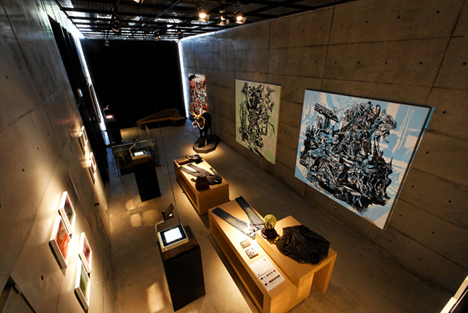 Diesel Denim Gallery in Tokyo, Aoyama mixes avant-garde art with a selection of premium Diesel clothes. “Instead of going to sign a deal with a famous artist [...] we think that if we start from scratch and build a relationship with new upcoming talent, we can gain status.” (Japan Times, August 23rd, 2007, Staying casual in Minami-Aoyama) Other fashion luxury brands to co-opt the art world include Paul Smith (http://www.paulsmith.co.uk/personal/space-gallery/, accessed 20.01.2008. The shop is spread over 4 floors with a gallery set on the 4th Floor. In the ‘Space’ Gallery, a varied line up of British and European artist, photographers, and product designers are exhibited. See SuperFuture Online, http://www.superfuture.com/city/reviews/review.cfm?ID=309, accessed 20.01.2008), Gucci and Louis Vuitton, with its famous “The Culture of Branding” show in collaboration with the artist Murakami Takashi. Currid (2007) considers these cooperations built on the fact: “[...] underneath the glamour and frivolity of art and culture are real social and economic mechanisms [...]” (Currid 2007: xi)
Other concepts include to move a whole brand upscale, as seen in the case of Isetan, a department store targeting male customers. By lining up high-end items on the top-floor of their store in Shinjuku as though they were museum pieces, they want to attract customers. The idea proved extremely successful by adjusting the product portfolio to the middle-aged male customer who seeks to make a fashion statement (The Nikkei Weekly, November 5th, 2007, Retailer finds way into men's wallets: 20). Ace Gene started in February 2007 to polish its luxury image and achieved a big increase in its profit margins by equally moving upscale (The Nikkei Weekly, September 3rd, 2007, Sales gains of 10% are for sissies, p. 21. After opening its Hibiya flagship store, Ace Gene discontinued internet sales and stopped marketing through general merchandise stores, increasing the luxury image. Prices were raised by 25%. Domestic sales from February to June were 80% higher). Baccarat Pacific K.K., a subsidiary of a major crystal ware maker from France, has been showing rapid growth after changing its brand strategy from a producer of dish wares to a luxury brand. The brand created an environment which made the buying process more of a lifestyle experience (The branches in Marunochi and Roppongi are examples where this has been implemented. See The Nikkei Weekly, Baccarat Pacific K.K., March 26th, 2007, p. 20. Baccarat experienced a 300% sales gain from 1996 to 2006. The new strategy tried to nurture Baccarat as a luxury brand that serves many aspects of the customers' lifestyles. Some stores are now equipped with trendy bars where visitors have the opportunity to enjoy drinking with the glasses they choose. The bartenders are trained with product specific information and in the history of the brand).
The creation of flagship stores of European luxury brands started in 2001 with the $138-million La Maison Hermes and since then other luxury brands have followed the trend of engaging top architects to create spectacular shopping palaces. “Japanese refinement of the retail experience plus a general lack of attachment to old structures drives a style of shop development that has produced some of the new architectural temples of the century.” (Superfuture superguide Tokyo, online, http://supertalk.superfuture.com/supershop/superguides/superguides-tokyo.php, accessed 20.10.2008) The latest overseas brands to appear in the upscale shopping district of Ginza were Bulgari and Armani, both in November 2007. Having a presence in Tokyo is considered an important part in the image-creation and also a jumping point to other Asian luxury markets (Japan Times, October 15th, 2007, Upscale saloons pamper rich: 52).
Luxury brand online stores have created services for customers that are beyond the scope of the average shopping site on the internet. It becomes more important for luxury brands and fashion houses to improve their presence known online, leading to the emergence of a new generation of virtual Japanese shopping towns (Examples are megaseek for men/mfm, select square, zozoresort, and 109 men's net, see “Virtual Luxury”, Anterior Insight 2008. Fendi launched on September 2006 a 15 seconds Video Ad exclusively on style.com, making a step away from print advertising on billboards and in magazines. Virtual shopping itself to become the new retail medium for many high fashion and luxury brands).
Luxury companies should devise creative ways in which they can take shopping out of the usual context, giving consumers the opportunity to discover new things and experiences. In this way luxury brands are connected with emotional values of diverse consumer lifestyles by connecting with the specific 'triggers' that make a consumer's brand experience enriching and unique (The Financial Times, September 9th, 2007, What luxury means now; “Convenience Luxury”, Anterior Insight 2008; Danziger 2005: 30; Graham and Matthews 2004).
Monday, April 7, 2008
HNWIs in Japan
The Analysis is dominated by populist depictions of social strata and groups that demand a lot of media attention. But to understand the changes, we have to look into a detailed consumer group analysis as well as major trends that are predominantly not covered in western press releases.
While the Japanese themselves are trying to make sense of the new business environment, one development seems to be clear, that the market has changed, that those who dont seem to change fast enough and try to adopt seem to get into difficulties or just face the threat of suffering major losses in the future. Not only the market has changed, other markets appear, where the money lies, where opportunities are waiting to be discovered not only by Japanese companies but also by foreign ones.
The buzz-words that are most common in marketing literature include the New Luxury movement and a trend toward lifestyle consumption, a global trend that gained wide coverage by books like trading-up and mass affluence as well as marketing groups like the Boston Consulting Group and otrher Luxury market research groups. While the trend in America may have slightly different underpinnings, the basic structure of the amassed welath is the same in Japan, with baby boomers facing retirement and young business people changing the face of being rich and the attitues toward luxury.
Limiting HNWIs in Japan to one segment is not explaining the complexity of the issue. A company has a product portfolio that does not make profit by catering solely to HNWIs. Limiting services to a part of the rich is a strategy, but for companies who offer consulting to other companies catering to the rich. A company catering to the premium market does not have the “luxury” of simplification.
While the Japanese themselves are trying to make sense of the new business environment, one development seems to be clear, that the market has changed, that those who dont seem to change fast enough and try to adopt seem to get into difficulties or just face the threat of suffering major losses in the future. Not only the market has changed, other markets appear, where the money lies, where opportunities are waiting to be discovered not only by Japanese companies but also by foreign ones.
The buzz-words that are most common in marketing literature include the New Luxury movement and a trend toward lifestyle consumption, a global trend that gained wide coverage by books like trading-up and mass affluence as well as marketing groups like the Boston Consulting Group and otrher Luxury market research groups. While the trend in America may have slightly different underpinnings, the basic structure of the amassed welath is the same in Japan, with baby boomers facing retirement and young business people changing the face of being rich and the attitues toward luxury.
Limiting HNWIs in Japan to one segment is not explaining the complexity of the issue. A company has a product portfolio that does not make profit by catering solely to HNWIs. Limiting services to a part of the rich is a strategy, but for companies who offer consulting to other companies catering to the rich. A company catering to the premium market does not have the “luxury” of simplification.
Subscribe to:
Posts (Atom)